

Nike pays $1.64 a share in dividends. Management just guided fiscal 2027 adjusted earnings to $1.15–$1.35.
That’s a payout ratio of 121% to 143%, before roughly $0.15 a share of restructuring charges that adjusted EPS leaves out. On GAAP earnings, the ratio runs closer to 137%–164%.
Steve Eisman put it bluntly last month: the dividend is higher than projected earnings, so Nike is burning cash to pay it, and that can’t last.
The stock is $39.46. The yield is 4.2%. Five years ago it was under 1%.
A yield that high on a brand this famous gets income buyers interested, but it should also make them nervous.
We need to know:
How much real cash Nike is generating once you strip out a one-time windfall from tariff refunds
How many years the balance sheet can carry the payout gap
What return on capital the business has to earn to pay $1.64 without help
Why the board’s November 2026 decision carries a lot of weight
What Eisman Got Right
Strip the one-time $986 million IEEPA tariff refund out of fiscal 2026, and EPS was $1.58, already below the $1.64 run-rate.
Guidance takes it lower. Consensus doesn’t clear $1.64 again until fiscal 2029, at $1.96.
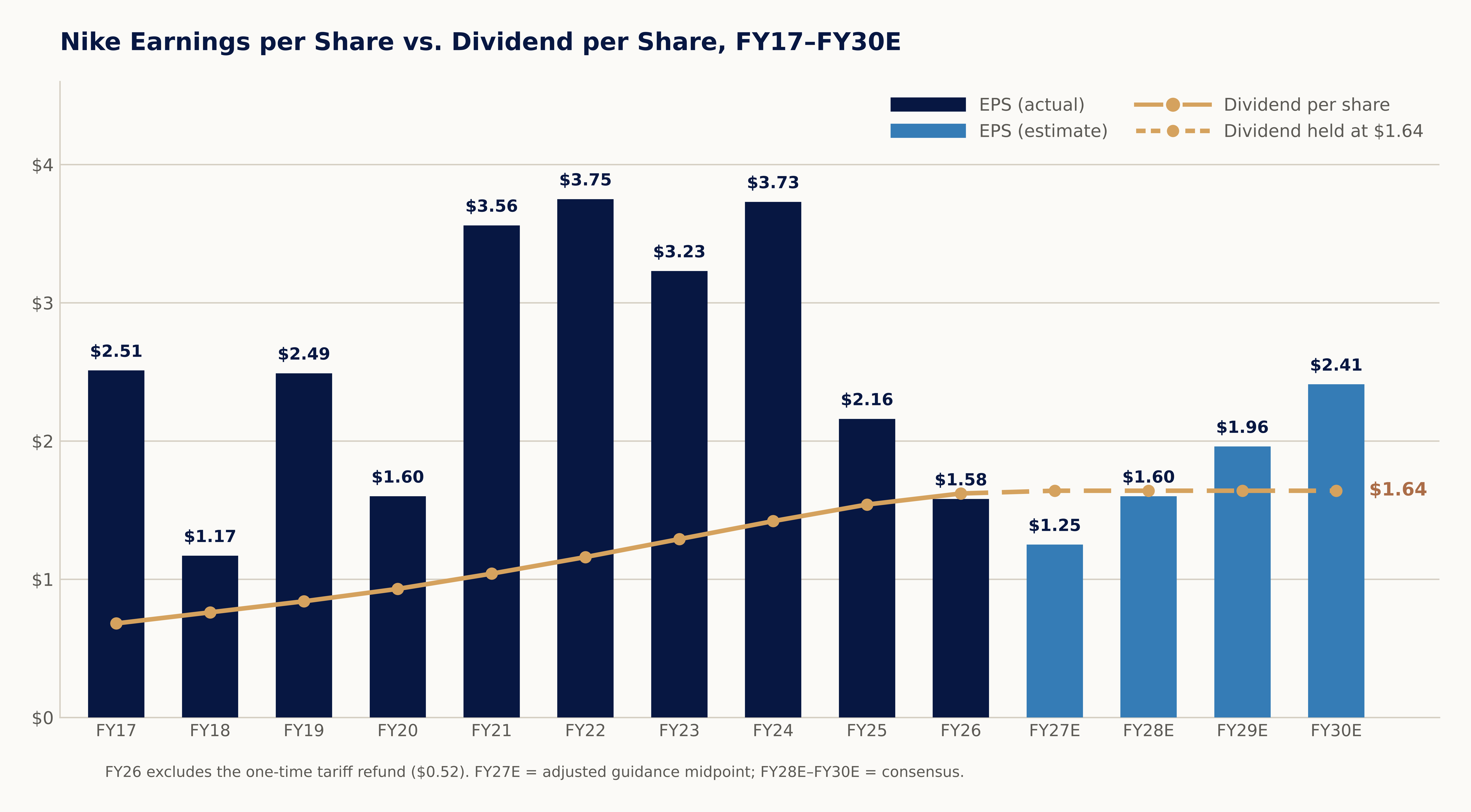
Based on the 2027 guidance of $1.25, EPS has to rise 31.2% just to cover the dividend at 100%. A dividend-growth investor tolerates coverage that thin only temporarily, and only if earnings are clearly back on a path to cover the payout.
The Refund Problem
Nike’s cash flows make the problem worse.
Fiscal 2026 free cash flow of $2.18 billion covered 91% of the $2.41 billion dividend.
But $302 million of that free cash flow was from the tariff refund. If we back that out, coverage drops to 78%.
The rest of the refund, $684 million, landed in fiscal Q1 2027, after the year closed. Even with that extra cash, Q1 free cash flow was negative $64 million. Without it, the quarter would have burned roughly $748 million before a single dividend was paid.
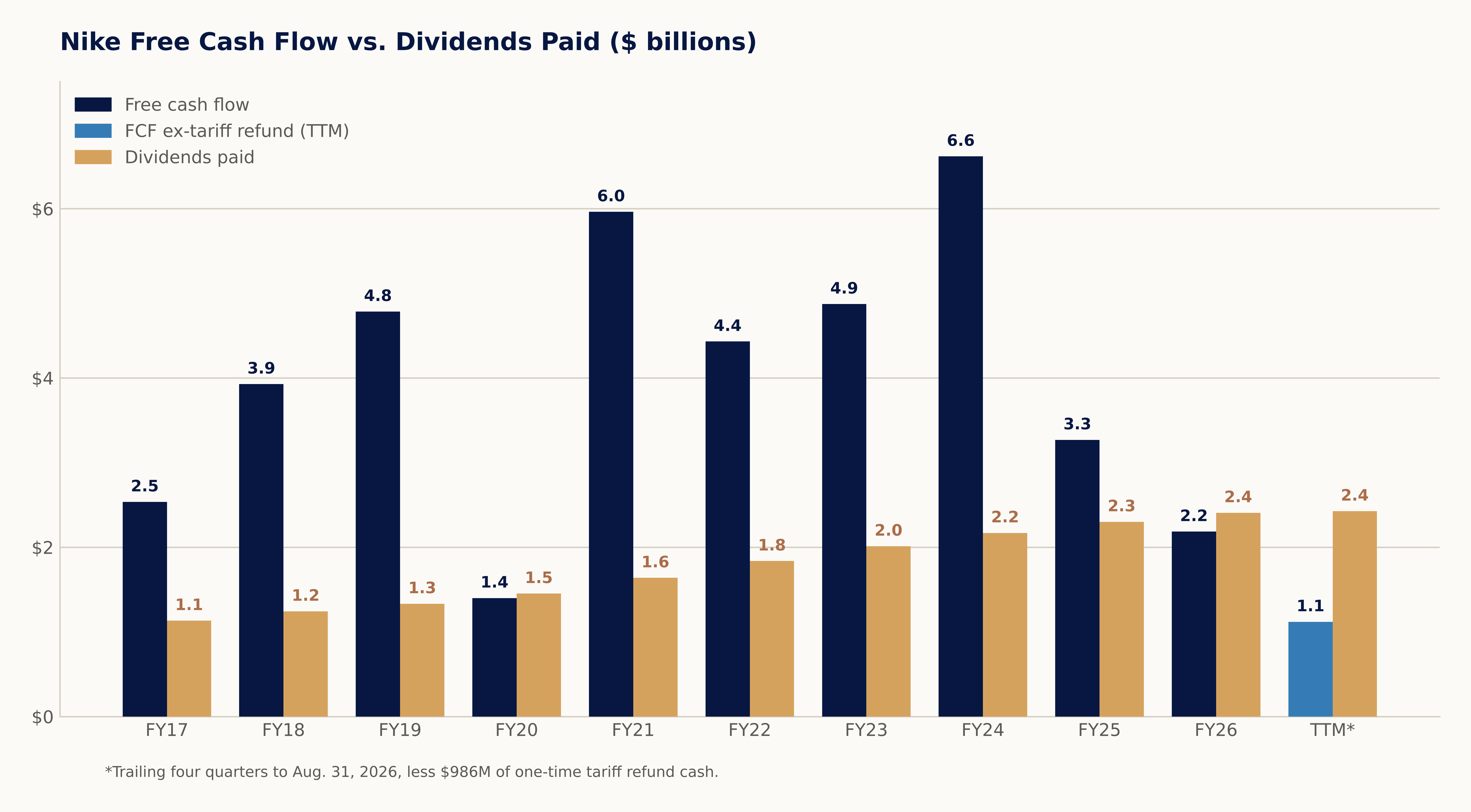
Over the trailing four quarters, free cash flow was $2.1 billion. Take out the full $986 million refund, and it’s $1.12 billion against $2.43 billion of dividends, 0.46x coverage.
S&P also cut Nike’s rating from A+ to A with a negative outlook, citing a roughly $1.2 billion annual cash shortfall after dividends for the next two to three years.
Nike’s free cash flow is also boosted by $715 million a year of stock-based compensation that is added back as a non-cash expense. With buybacks now shut off, that dilution matters more.
The Cash Bridge
The good news is this doesn’t mean Nike has to cut its dividend immediately.
Nike ended August with $8.37 billion in cash and short-term investments. It can fund a $1.2 billion annual gap for a while.
But for how long? And when is cash too low?
For a floor, I used fiscal 2019, when Nike ran a $39.1 billion business on $4.66 billion of cash and short-term investments, about 11.9% of sales. Scale that to roughly $42.7 billion of fiscal 2027 sales, and the comfortable minimum is about $5.1 billion.
Nike appears to have paid off its $1 billion of 2.375% notes from cash when they matured on November 1, rather than refinancing them. That leaves roughly $7.4 billion of cash and short-term investments, before whatever it burned in September and October.
Nike avoids replacing 2.4% debt at today’s 5%-plus rates, but it spends $1 billion of the cushion that funds the dividend. Another $1 billion of 2.75% notes comes due March 27, 2027.
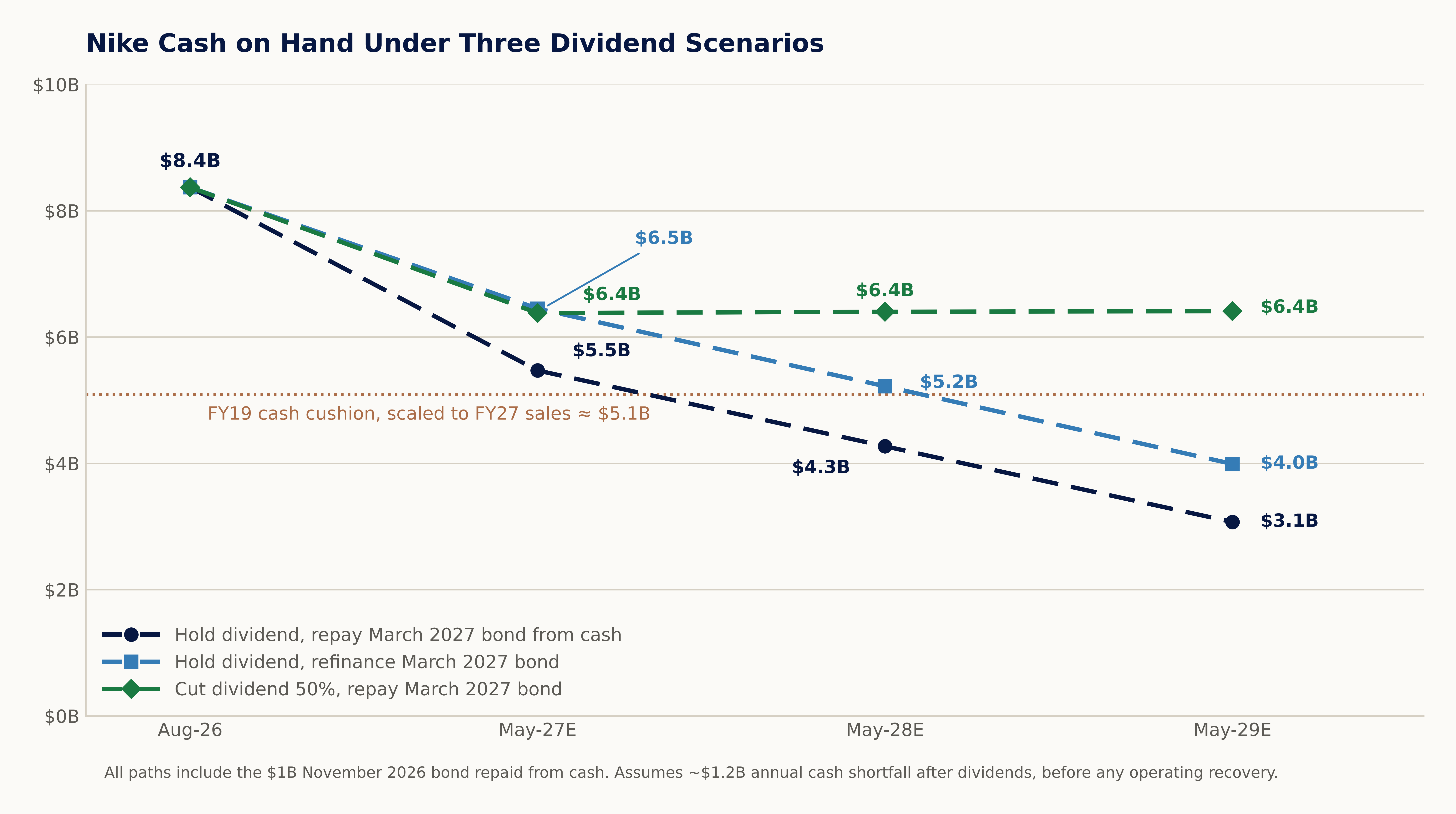
Three paths, assuming no operating recovery:
Hold the dividend and repay the March bond too: cash falls to about $5.5 billion by May 2027 and $4.3 billion by May 2028.
Hold the dividend and refinance the March bond: with November already paid from cash, cash sits at about $5.2 billion by May 2028, right at the floor, and falls below it in fiscal 2029. Nike is still rated A, and refinancing $1 billion at today’s yields costs roughly $25–30 million a year more in interest.
Cut the dividend in half: a $0.205 quarterly payout saves $1.22 billion a year. That’s almost exactly S&P’s projected shortfall. Cash holds near $6.4 billion, even after repaying the March bond.
Management says the Pace restructuring delivers about $2.5 billion of savings, at roughly $1 billion of cost, with the peak landing in fiscal 2029 and 2030. Management is expecting the drag from China to extend through fiscal 2028 before it turns.
The balance sheet can carry the dividend to fiscal 2028 without much strain. If the earnings recovery comes in 2029, then Nike only needs its balance sheet to carry the dividend for a year to a year and a half.
It’s not this year but next year when the board may have to make a difficult decision if earnings and cash flow don’t recover.
The Returns Behind the Dividend
The other factor we have to consider in any potential cut is returns on capital. Can the business fund itself on its own without accessing external capital?
I calculated ROIC as net operating profit after tax (NOPAT) over average invested capital, with NOPAT equal to EBIT times one minus cash taxes paid over pre-tax income. Invested capital includes operating leases and is net of all cash and short-term investments.
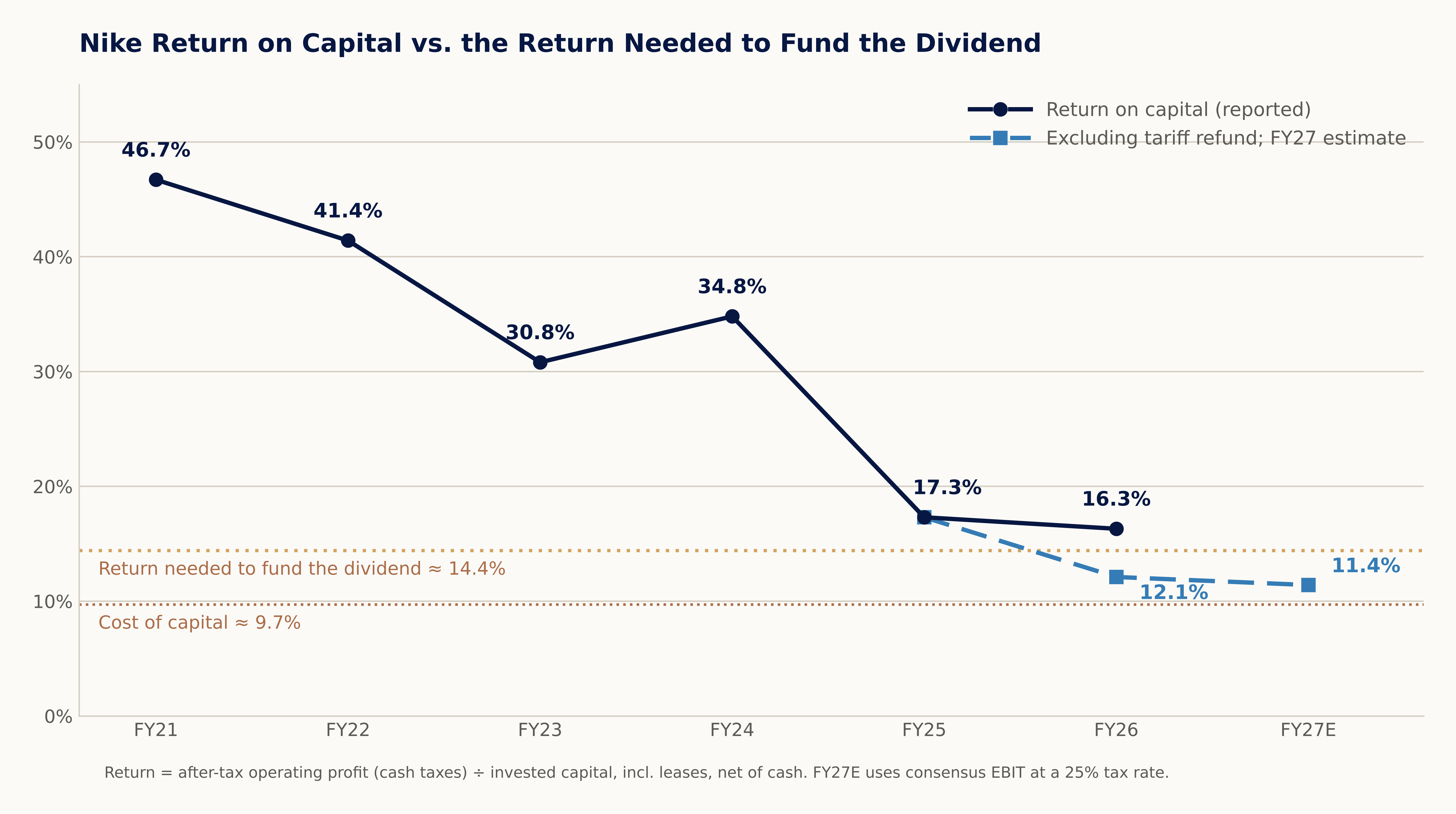
ROIC was 46.7% in fiscal 2021 and 34.8% in fiscal 2024. Then it fell to 17.3% in fiscal 2025 and 16.3% in fiscal 2026.
Strip the $986 million tariff refund out of fiscal 2026 EBIT and ROIC drops to 12.1%. That figure uses cash taxes, which makes it harsher than Nike’s own 18.7% effective rate. Cash taxes ran 32.6% of pre-tax income last year, inflated by a $268 million final installment of the 2017 repatriation tax. Normalize the rate to 22%, and ex-refund ROIC is about 14.0%.
Nike’s dividend costs $2.43 billion. Invested capital ended fiscal 2026 at $16.9 billion. Divide one by the other and you get 14.4%, the ROIC Nike must earn just to cover the dividend before it reinvests a dollar.
For Nike today, that floor is close to the real requirement, because the company barely reinvests in fixed assets. Capex ran $684 million in fiscal 2026 against $747 million of D&A. With almost no net capex to fund, nearly all of NOPAT is available to shareholders. If Nike clears 14.4%, the dividend is covered. If ROIC falls short, then the dividend is being funded from the balance sheet.
Growth changes the math. If Nike wants to grow its capital base 5% a year, it needs ROIC closer to 19%.
Ex-refund ROIC of 12%–14% sits at or below the floor before any growth. Consensus fiscal 2027 EBIT of $2.59 billion implies about 11.4% ROIC, which forces Nike to fund its dividend from the balance sheet.
Then there’s the incremental return.
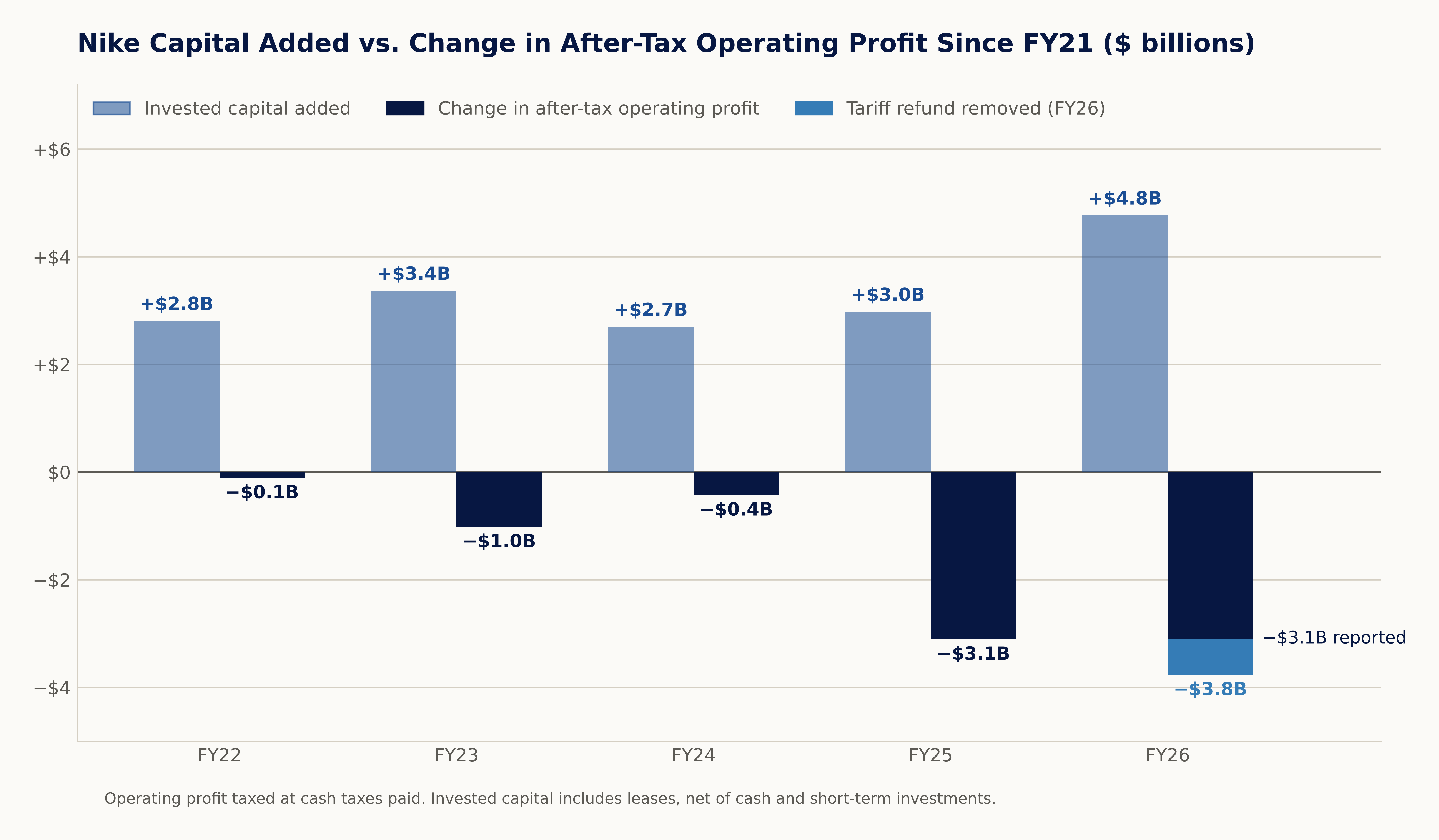
Since fiscal 2021, invested capital has grown from $12.1 billion to $16.9 billion. NOPAT went the other way, from $5.70 billion to $2.60 billion, or $1.93 billion without the refund.
ROIIC is negative on every multi-year window.
Over the five years to fiscal 2026, NOPAT fell $3.1 billion while the lagged capital base rose $2.8 billion. Most of the added capital sits in working capital. Operating working capital rose $1.36 billion in fiscal 2026 alone; about half of it was the refund receivable that has since been collected.
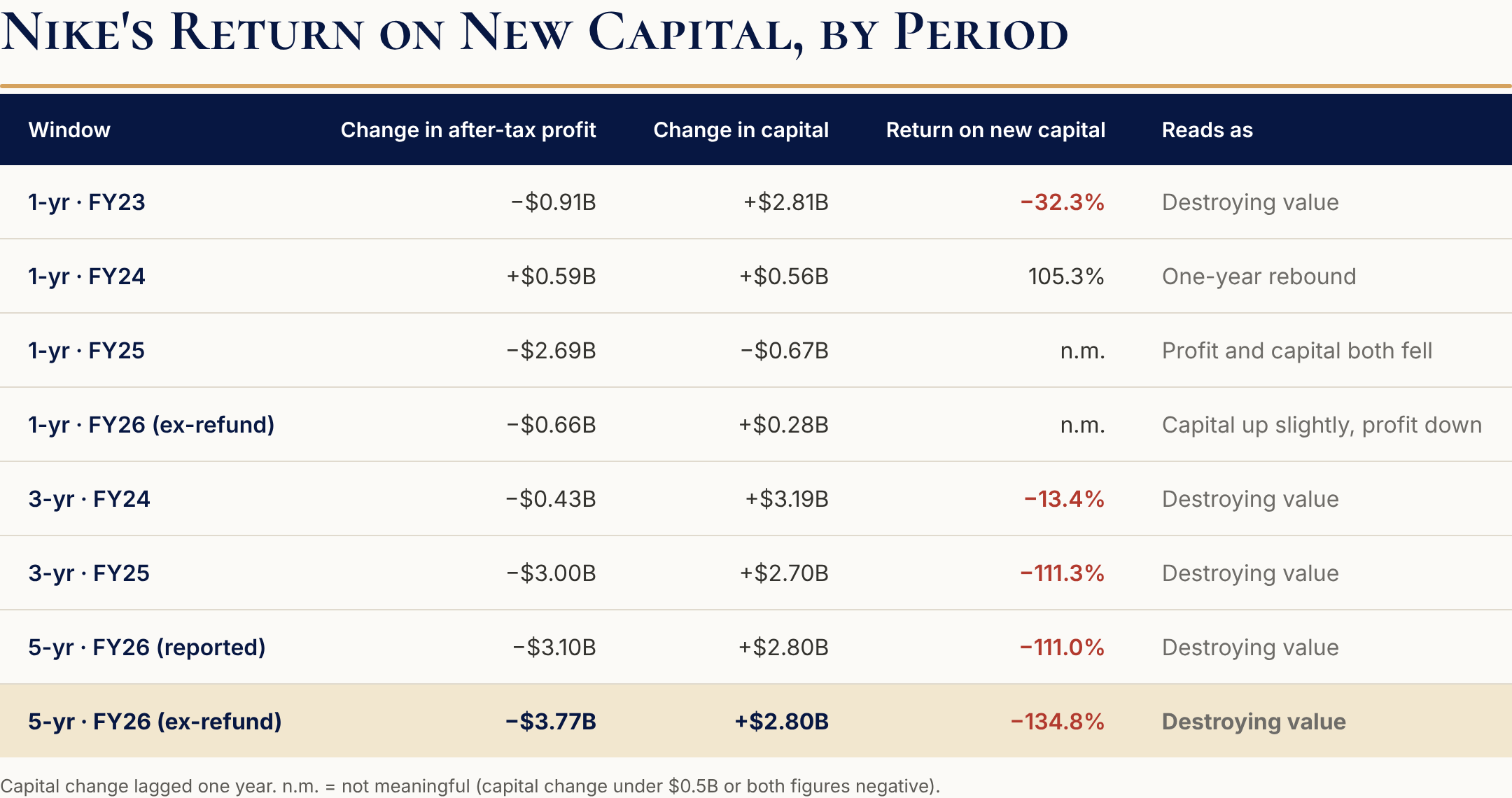
The one positive window in the past four years was fiscal 2024: $0.59 billion more NOPAT on $0.56 billion more capital. It reversed the next year. Every three- and five-year window is negative, and the five-year read without the refund is −134.8%.
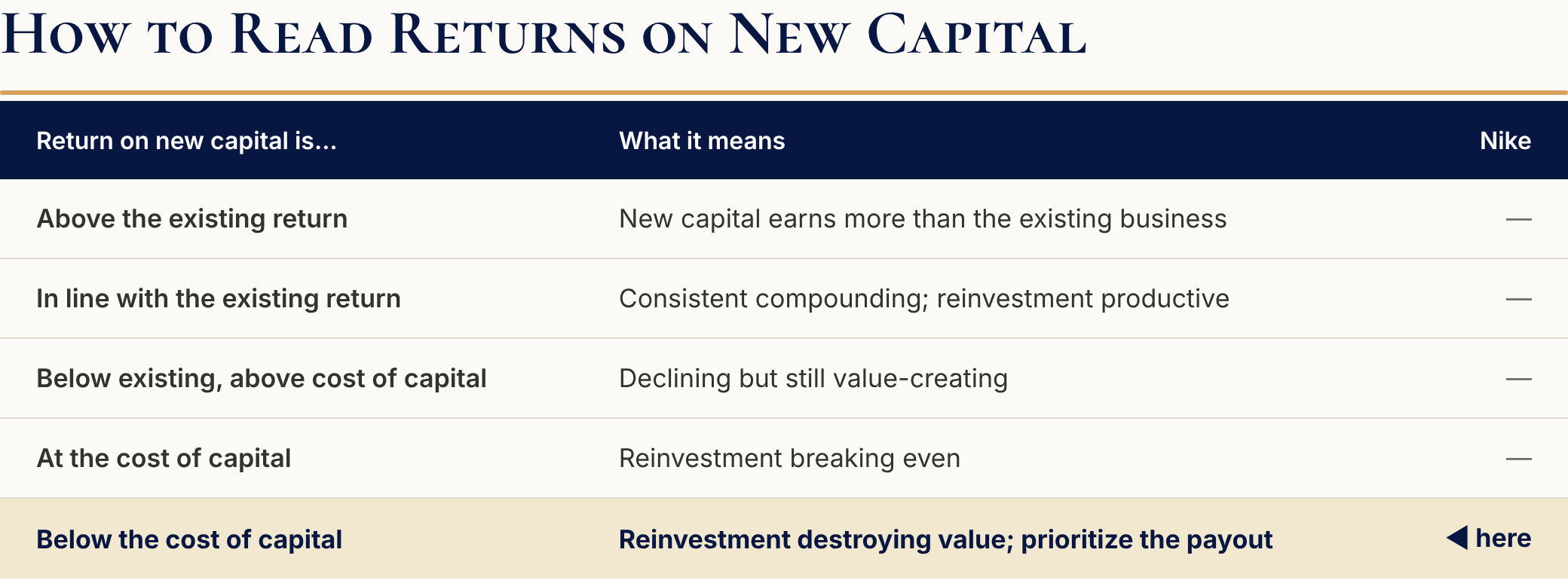
On the returns framework, Nike is currently in the bottom row, ROIIC below the cost of capital. The textbook answer is to stop reinvesting and send the cash to shareholders.
But the issue isn’t Nike over-investing. The problem is the numerator. Margins collapsed on a roughly stable capital base, so there’s no reinvestment to cut that would free up dividend money.
Two ways to read this as a dividend investor.
The cut case is weaker than the cash flow alone suggests. Even at 12.1%, Nike still earns more than its ~9.7% cost of capital. Boards cut dividends when the business can no longer fund them. Nike still can, but just barely.
The growth case is gone until margins return. Dividend growth needs NOPAT growth, and with ROIIC negative, there’s none to fund it. Any raise in November is a token raise, and it’ll be funded by the balance sheet.
To fund the current dividend from NOPAT at a 25% tax rate, Nike needs about $3.24 billion of EBIT, a 7.6% margin on roughly $42.7 billion of fiscal 2027 sales. To resume 8% annual dividend growth for three years, it needs about $4.1 billion, or a 9.6% margin. Fiscal 2026 was 6.2% without the refund, and back in fiscal 2024, Nike’s margin was 12.7%.
The 25-Year Line
Nike raised its dividend in November 2025 from $0.40 to $0.41. That’s a 2.5% increase, after 8.1% the year before and 8.8% the year before that. That penny was the 24th consecutive annual increase.
One more raise makes 25, and Nike becomes a Dividend Aristocrat.
The cost of keeping the streak alive is tiny. Another penny, to $0.42, costs about $59 million a year. The cost of breaking it one year short of 25 is far costlier in reputation with dividend growth investors and a stable shareholder base.
Nike usually declares its raise in mid-November. Its Investor Day is November 16–17, where management has promised a five-year financial algorithm for both revenue and earnings growth. And CFO Dave Denton, asked directly on the October 1 call whether the dividend is safe with the payout over 100%, said that under all scenarios Nike can maintain and ultimately grow it.
Of course. CFOs say this until the day they can’t. But “maintain and ultimately grow,” said on October 1, about seven weeks before both the 25th-year decision and the five-year plan, reads to me like a board that has already chosen the token raise.
Three Paths for November
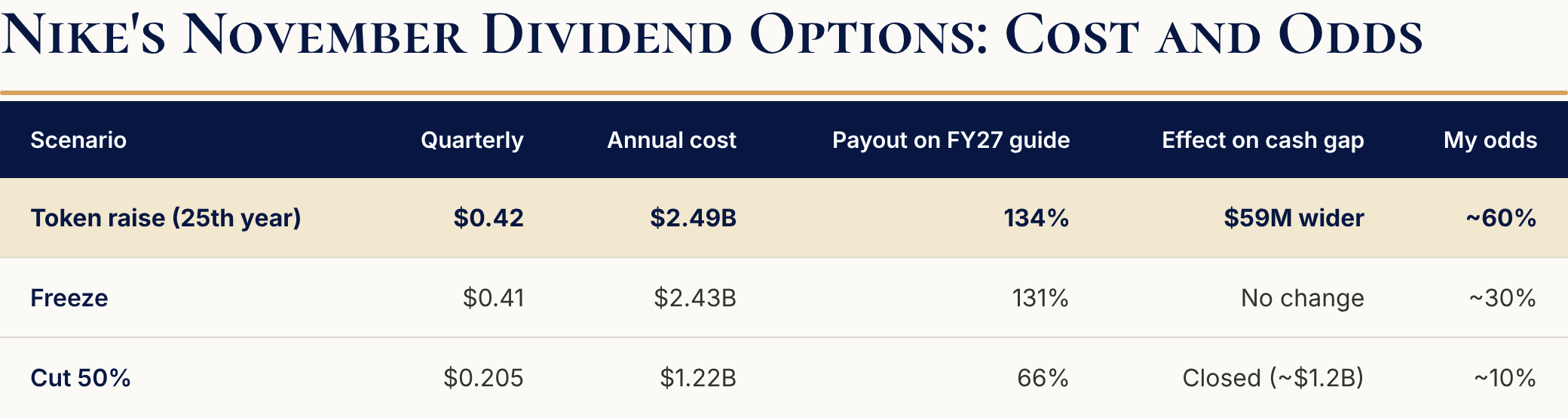
I put roughly 60% on a token raise, 30% on a freeze, and 10% on a cut this November.
A freeze would be the prudent move, but I think the board highly values becoming a member of the Dividend Aristocrats, so it would choose the token raise.
A cut this November looks highly unlikely to me. The cash is there. The credit rating is still A. And cutting the dividend before the Investor Day would undercut its turnaround message.
The 24-month picture is different. If fiscal 2028 earnings land near the $1.60 consensus, still below the dividend, and cash is heading toward $4–5 billion, the board faces a harder choice. I put the odds of a cut by late 2028 at about 35%.
The Verdict
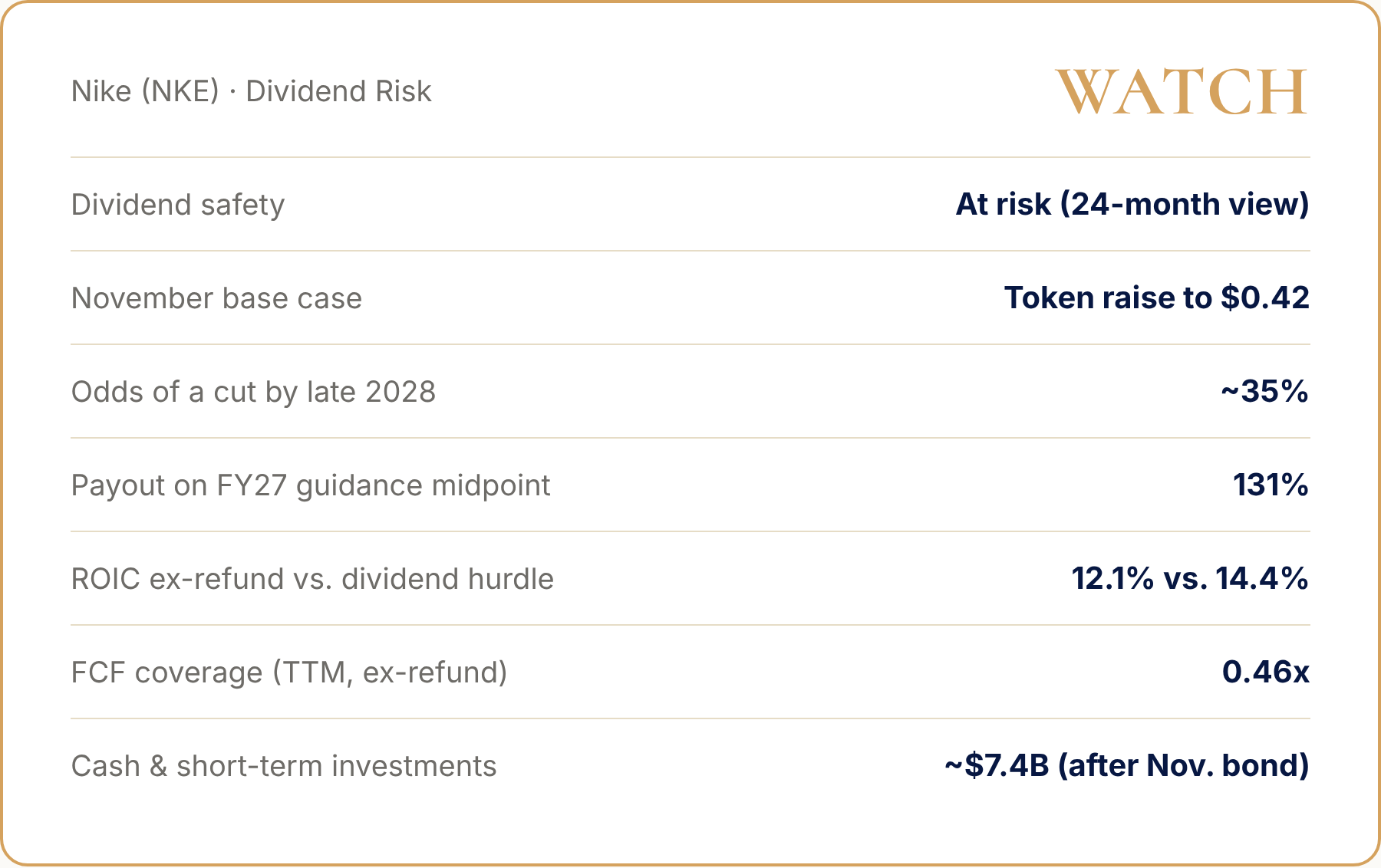
Eisman is right about the arithmetic. Nike is paying out more than it earns and more than it generates in underlying free cash flow, and has been for a year.
But I think he is early on the cut.
The balance sheet funds the payout gap through fiscal 2027 and most of 2028, the business still earns more than its cost of capital, and the board has every incentive to buy a 25th raise for $59 million.
So the dividend probably survives November.
Nike today is a turnaround that happens to pay a high yield, but that yield is the part most at risk if the turnaround takes longer than expected or doesn’t come. I wouldn’t buy NKE for the 4.2% yield. If you own it for the value in a turnaround and brand recovery, then look into underwriting and sizing your position as if the dividend gets cut in half, because that would immediately close the payout gap.
Call: WATCH. Revisit after the November declaration and Investor Day.